
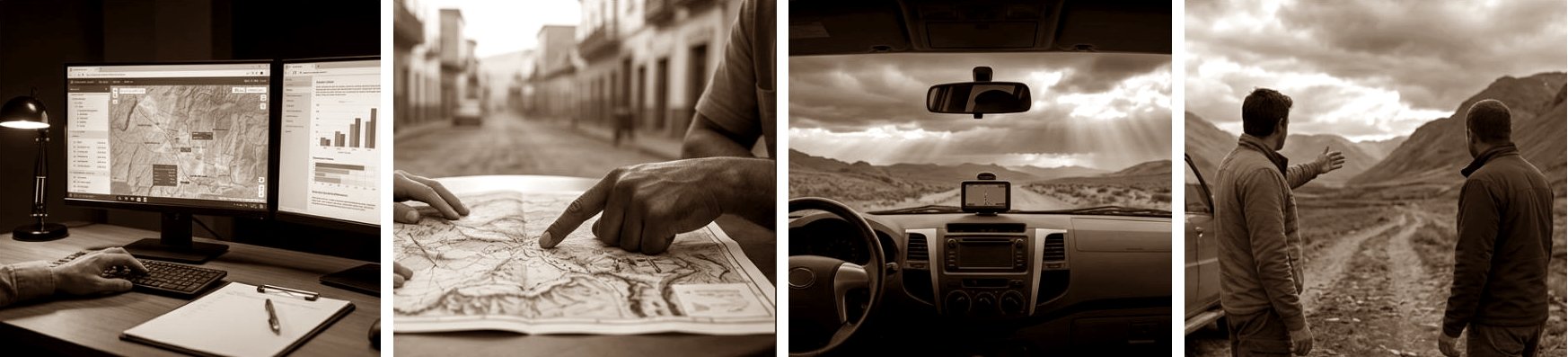
WHAT WE DO
Assessment, adaptation, preparation and coordination
Emporos helps clients understand what a proposed activity will require in a particular place, determine whether the proposition is workable and establish the arrangements needed to proceed.
The work is scoped to a defined objective. A client may commission an assessment alone, or extend the engagement into adaptation, preparation and coordination.
Scope and mandate
The purpose is not to produce a comprehensive study of a country or destination. It is to establish how the operating environment may affect a particular proposition, verify the matters on which the decision or activity depends and advise what should follow.
Before work begins, a written mandate records the objective, questions, geographic scope, method, deliverables, timing, reporting arrangements, professional boundaries and any authority to act on the client’s behalf.
Assessment
Assessment starts with the objective and the questions on which the decision depends.
Context analysis
Research is confined to the conditions, dynamics and dependencies that may affect the proposed activity and, where relevant, the way the activity may affect its surroundings.
Depending on the mandate, this may include access and movement, security and hazard conditions, infrastructure and services, administrative requirements, provider capability, relevant institutions and communities, and dependencies on external decisions or resources.
The assessment identifies what can be established remotely, what requires first-hand verification and which questions belong with legal, financial, technical, medical, security or other specialists.
Field verification
Where direct examination would materially improve the decision, critical assumptions are tested through local enquiries, direct observation, meetings with counterparts and providers, and inspection of relevant sites, routes, venues, accommodation or proposed arrangements.
Where research is sufficient to answer the question, the assessment can conclude without fieldwork.
Reporting / Advisory
The assessment report sets out the evidence, its limitations and its implications for the proposition.
The conclusion states whether the activity appears workable as presented, workable subject to specified changes or unsupported under current conditions, with practical options and next steps.
The report distinguishes, where relevant, direct observation, documentary or third-party information, analytical judgement and unresolved uncertainty.
Adaptation
Clients often arrive with a proposition already developed by their own specialists: an itinerary, programme, opening, investor visit, relocation or mobilisation.
Emporos applies the assessment to that proposition.
Where the client has its own planning capability, Emporos identifies the changes, sequencing and local arrangements required for the proposition to work in the location and supports the client team as it finalises them.
Where the client requires a locally configured solution, Emporos can develop the operational arrangements directly for approval. Depending on the assignment, these may cover routes and timings, venues and accommodation, transport, communications, medical and security arrangements and the local providers responsible for each element.
Providers are assessed against the client’s stated requirements and presented as a recommended configuration, with alternatives where appropriate.
The resulting document may take the form required by the client’s sector: a visit or itinerary plan, destination or local-arrangements plan, pre-opening plan, investor programme, mobilisation and site-access plan, relocation plan or programme start-up plan.
Preparation
Preparation begins once the client has approved the proposition.
Emporos establishes and tests the access, relationships, providers and practical arrangements required before travel, relocation, mobilisation, opening or deployment.
Depending on the assignment, this may include:
advance work for visits, delegations, conferences, tours, openings and mobilisations;
inspection of relevant venues, accommodation, sites and routes;
liaison with counterparts, institutions and communities on whose cooperation the activity depends;
confirmation of movement, transport, timings and communications, including workable alternatives;
briefing of local providers against agreed operating requirements;
integration of requirements from the client’s legal, medical, security, technical and other advisers.
A readiness record identifies what has been confirmed and tested, responsibilities assigned, alternatives prepared and matters still outstanding.
Coordination
Coordination begins when the activity moves into its critical phase.
The adviser works with the client’s team, coordinating agreed arrangements, liaising with counterparts and providers, representing the client within the authority set out in the mandate and following actions through to handover.
Where conditions change, Emporos assesses their implications for the client’s people, plans and activity.
Matters within the mandate are addressed locally. Those requiring client authority are escalated promptly with a clear account of the issue, available options and a recommendation.
The engagement closes with an agreed handover of responsibilities, unresolved matters and actions still to be carried forward.
Access in practice
Access is not simply movement from one place to another. It is the practical ability to reach a location, move within it, conduct the intended activity and secure the cooperation required for it.
That may depend on physical access, formal permissions, local relationships, provider capability, infrastructure, communications, community and institutional interfaces and the way the proposed presence is understood.
Emporos considers these factors in relation to the client’s objective and advises on the practical adjustments or arrangements they require.
Security and hazards in context
Security and hazard conditions form part of the wider operating environment.
Emporos draws together relevant information from official, United Nations and non-governmental sources, local specialist organisations and direct observation, and advises on what those conditions mean for the proposition.
This may include the activity’s operating posture, movement, profile, timing and the proportionality and practical fit of proposed protective arrangements.
Where technical work is required, such as explosive-ordnance survey, medical planning or protective security, Emporos identifies the appropriate certified or licensed specialist and coordinates that input on the client’s behalf.
Hazard findings are indicative and source-attributed. Emporos does not provide security services or certify that a location is free from danger.
Client standards, applied locally
Emporos works against the client’s applicable policies, procedures and provider requirements, whether these concern duty of care, health and safety, safeguarding, brand standards or programme governance.
This often requires interpretation in both directions: explaining what local conditions mean for the client’s requirements and translating those requirements into practical expectations for local providers.
Where local conditions and client requirements cannot be reconciled, Emporos reports the gap and the available options rather than treating a nominal arrangement as adequate.
Reporting
Reporting follows the next decision.
Depending on the assignment, the output may be an oral briefing, decision note, assessment report, readiness report, progress update or handover record.
The aim is not simply to record findings, but to explain what they mean for the client’s proposition.
Engagement models
Emporos can be engaged directly by a client or through a commissioning adviser or professional firm.
Assignments may be structured as:
Assessment — a defined question answered before commitment.
Assessment and adaptation — a decision informed, followed by changes to the proposition or locally configured arrangements ready for approval.
Full assignment — assessment, adaptation, preparation and coordination through handover.
Retained arrangement — call-off support for firms or clients with recurring requirements.
The reporting line, duration, authority to act and professional boundaries are agreed before work begins.
Professional boundaries
Emporos assesses the operating environment around a proposition. It does not advise on the commercial merits of an investment, market, transaction or counterparty.
Provider assessment is confined to the requirements and evidence defined in the mandate and does not constitute financial, integrity or legal due diligence.
Emporos develops and coordinates arrangements. Contracts with travel, accommodation, security and other providers are held by the client or its appointed operator.
Legal and regulatory advice, permits, taxation, finance, clinical judgement, engineering, protective security, explosive-ordnance survey and clearance, emergency response and other reserved professional services remain with qualified specialists.
Emporos can identify, brief and coordinate specialist inputs without replacing the professionals responsible for them.
Specialist workstreams
Stakeholder and local-acceptance review
Assessment of the communities, institutions, civil-society organisations and other stakeholders relevant to a proposed presence or project, including their interests, relationships and likely concerns, and the engagement priorities that follow.
Conflict-sensitivity analysis
Analysis of the actors, divisions and grievances relevant to an activity and how the activity may interact with them, together with the operating posture and safeguards required.
Security arrangements review
An independent review of proposed or existing security arrangements, considering proportionality, practical fit with the setting, operating posture and profile, effects on acceptance and community relations, conflict sensitivity and provider conduct against recognised standards where applicable.
The review is advisory. Emporos does not provide or manage security services.
Preliminary field hazard scoping
An early, largely desk-based assessment of hazards that may affect a site, route or activity, including access, infrastructure and environmental conditions and, in conflict-affected areas, the potential for explosive ordnance contamination.
Findings are indicative. Where focused survey or other technical work is warranted, Emporos identifies and coordinates the appropriate specialist.
Resilience and crisis preparedness
Scenario and contingency planning, relocation and evacuation planning, exercises and crisis communications, aligned with the client’s existing arrangements and undertaken with the responsible specialist providers.
Independent fact-finding and review
A structured account of events following an incident, provider failure or conflicting reports, distinguishing established facts, source accounts, unresolved issues and recommendations.